Mobile Development · November 15, 2026 · 9 min
How Much Does a Mobile App Cost in Malaysia? (2026 Guide)
App prices in Malaysia run from about RM15,000 to RM300,000. Here is what each type costs in 2026, what drives the price, and what to check before you sign.

Written by
Khaleeq Ahmad
Mobile (Android) Developer
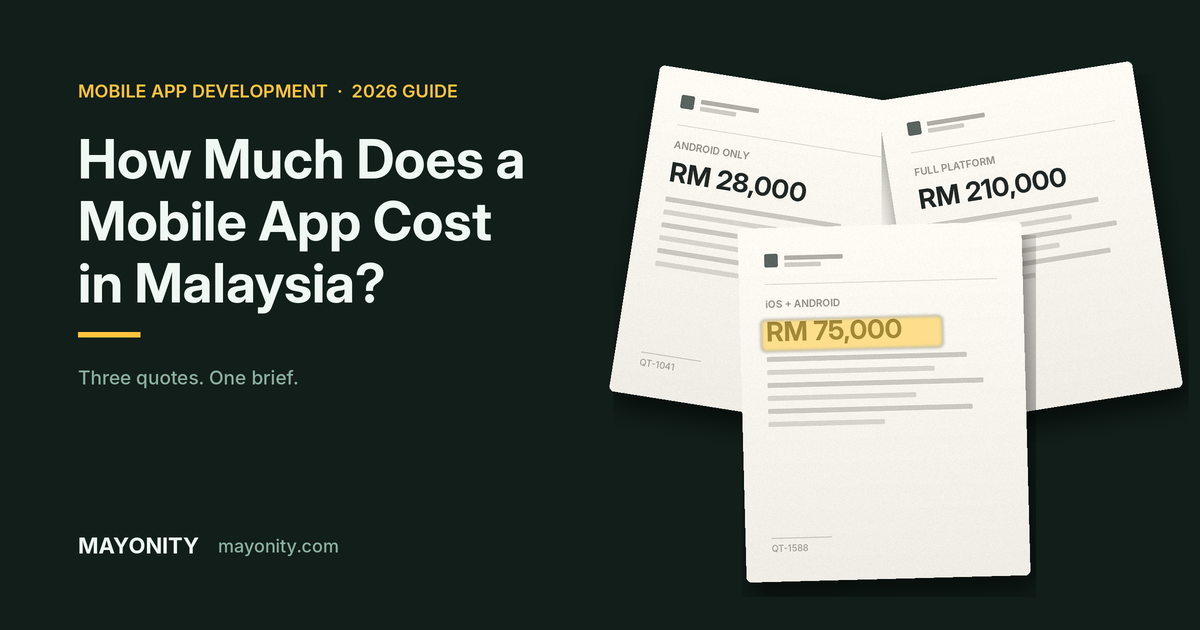
A client in Kuala Lumpur once showed us three quotes for the same app idea. RM28,000, RM75,000 and RM210,000. He assumed two of the three were trying it on.
None of them were. The cheap one covered Android only, no backend, and a template design. The expensive one included an admin system, an integration with his existing stock software, and a year of support. They were quoting three different projects, and only one of them matched what he actually needed.
That is the real problem with app pricing in Malaysia. The numbers are meaningless until you know what sits behind them.
What the market actually charges
Pulling together the Malaysian agency pricing guides published through 2026:
| App type | What it usually includes | Typical cost | Timeline |
|---|---|---|---|
| Simple app / MVP | One platform or cross-platform, a few screens, no complex backend | RM15,000 – RM60,000 | 1 – 3 months |
| Mid-tier business app | iOS and Android, user accounts, payments, admin panel | RM40,000 – RM150,000 | 3 – 5 months |
| Advanced app | Real-time features, complex logic, analytics, AI | RM80,000 – RM300,000 | 5 – 9 months |
| Enterprise platform | Multiple modules, legacy integrations, strict security | RM150,000 – RM500,000+ | 8 months and up |
Most SME projects land between RM40,000 and RM150,000.
Notice how far the bands overlap. That is not sloppiness in the data. Studios genuinely disagree about where "simple" ends and "mid-tier" begins, so the same brief lands in different buckets depending on who reads it.
Hourly rates are more consistent. Freelancers run roughly RM80 to RM200. Agencies charge RM150 to RM350. Senior specialists working on fintech, security or native performance ask RM400 and up. For comparison, the Malaysian studios listed on Clutch, Snappymob and Techies App among them, publish rates of USD 50 to 99 an hour with a USD 10,000 minimum project.
Sources are listed at the end of this article.
Where the money goes
Platforms. Two native apps cost close to double one cross-platform build. React Native and Flutter now handle most business apps perfectly well, and the money saved is better spent elsewhere. Native still wins for heavy graphics, intensive camera work, or anything where you are fighting for milliseconds.
Anything behind a login. This is the single biggest jump in most quotes. An app that just displays information is simple. Add accounts, permissions, an admin panel and a database and you have built a system, not a screen.
Payments. Connecting FPX, cards and the e-wallets your customers use is not a weekend job. There is a merchant account to open, a gateway to integrate and a lot of testing, because payment bugs cost real money.
Languages. Bahasa Malaysia, English and Chinese means three versions of every screen, every notification and every error message. Decide this at the start. Retrofitting it is miserable.
Your existing systems. If the app has to talk to your accounting or inventory software, ask the vendor whether that software has an API before anyone quotes. A closed system with no API can double the integration work on its own.
Design. Original UI and UX usually adds RM8,000 to RM20,000 over a template. It is also, in our experience, the thing that decides whether people keep the app past the first week.
The year-two problem
Most quotes cover the build. Almost none mention what happens afterwards, and this is where budgets quietly break.
Apple and Google ship new operating system versions every year. Each one has the potential to break something in your app. Libraries get deprecated, certificates expire, payment gateways change their APIs. An app that nobody touches for two years usually stops working, and fixing a neglected app costs more than maintaining a healthy one.
The Malaysian guides suggest budgeting 15 to 20 percent of the build cost annually for maintenance. On a RM60,000 app that is RM9,000 to RM12,000 a year. Add hosting at RM200 to RM2,000 a month depending on your user numbers, plus Apple's annual developer fee, Google's one-off registration, and whatever your SMS, maps and payment services bill you.
None of that is optional. Factor it in from the first meeting or you will be surprised in month fourteen.
Should you hire locally?
A Malaysian studio sits in your time zone, can meet you in person, and understands the local market without being briefed on it. For some projects that is worth paying for, and anyone who tells you otherwise is selling something.
Offshore teams charge less because their costs are lower. We are one of them, so take this with the appropriate pinch of salt, but the honest version is that the saving only holds if the working relationship is sound.
What actually goes wrong with remote development is rarely the code. It is a client who approved a vague scope, then discovered in month three that what was built is not what they pictured. Or a vendor who goes quiet for two weeks and resurfaces with something unrecognisable. Distance makes both of those worse.
So whether you hire in Kuala Lumpur or elsewhere, insist on the same three things: a written scope you have actually read, something working you can open on your own phone every week or two, and one named person who answers when you message. Get those and location matters far less than people think.
Make them put it in writing
Before you compare totals, make every studio answer these on paper:
- One platform or both?
- How many screens, and is the design custom or adapted from a template?
- Is the backend and admin panel in this price, or quoted separately?
- Which integrations are included?
- What happens when we change our mind about a feature halfway through?
- Who owns the source code and the app store accounts when we are done?
- What does support cost after launch, and what does it actually cover?
That last pair catches more people than anything else. Plenty of businesses discover a year in that the developer owns their Apple account, or that "support" means bug fixes only and every small change is billed separately.
About the RM3,000 app
Somebody will offer to build the whole thing for RM3,000. Something is always missing: the backend, the testing, or the developer, who will not be reachable in six months.
We have rebuilt enough of these to say it plainly. Rebuilding costs more than building once.
What you can build on a startup budget
Most of the people who email us are not funded. They have RM20,000, an idea they believe in, and a table like the one above telling them they need RM80,000.
They usually do not need RM80,000. They need a smaller first version.
At RM15,000 to RM25,000 a first version is realistic, as long as you cut scope and not quality. In practice that means:
- One platform to start. Launch where your users already are, and add the second platform once the first one earns it.
- Four or five screens instead of twenty. Sign in, the one thing the app is for, a list, a detail view, a profile.
- Payments through a hosted gateway rather than a custom checkout. Billplz, ToyyibPay and Stripe all wire in within a day.
- No admin panel in version one. Run it from the database or a spreadsheet until there are enough users to justify building a screen for it.
- Design built on a proper component library instead of a visual language drawn from scratch.
Three things should not be cut: testing, a backend you own and control, and code another developer can pick up. Those are what make version two cheap. Skip them and you pay for the app twice.
We quote a first phase like this as a fixed price before any work starts, and our own project minimum is USD 1,000, roughly RM4,500, so a small and clearly scoped piece of work is something we will take. If your budget cannot carry the app you have in mind, we would rather tell you what it can carry than stretch the scope and run out of money halfway.
Frequently asked questions
How much does a simple app cost in Malaysia?
Roughly RM15,000 to RM60,000 according to 2026 guides, taking one to three months.
What is the minimum budget for an app in Malaysia?
A genuine first version starts around RM15,000. Below that you are buying a template, and below RM10,000 you are usually buying something that has to be rebuilt. If your budget is under RM15,000, cut the feature list rather than the build quality.
How long does it take to build an app?
One to three months for something simple. Three to five for a mid-tier app with accounts and payments. Longer for anything complex, and considerably longer if the scope keeps moving.
Should I build for iOS and Android separately?
Usually not. A cross-platform build covers both from one codebase and costs far less. Go native when you need serious performance or deep access to device hardware.
What will it cost every year after launch?
Budget 15 to 20 percent of the build cost for maintenance, plus hosting and third-party service fees.
Can the app accept FPX and e-wallet payments?
Yes. A Malaysian gateway handles FPX, cards and the common e-wallets. You open the merchant account; your developer does the integration and testing.
Getting a number for your own app
If you have an idea and want to know what it would honestly cost, tell us what you are planning. We ask questions first, then send a written scope and price. If your idea would be better served by an off-the-shelf tool, we will say that too.
You can also read how we work with businesses in Malaysia, or about our mobile app design and app development services.
Sources for price ranges
- Advisory Apps: Cost to develop an app in Malaysia 2026
- Wowonini: Cost to build a mobile app in Malaysia (2026)
- Gotchaa Lab: Mobile app development cost in Malaysia
- PhiSoft: What a mobile app costs in Malaysia
- Vigital Solutions: Software and app development cost in Malaysia (2026)
- Red Ant Technology: How to estimate app development cost
- Techies App: Best mobile app development companies in Malaysia (2026)