Business · November 21, 2026 · 8 min
How Much Does Custom Software Cost in Australia? (2026 Guide)
What custom software really costs in Australia in 2026 — local price ranges by project type, what pushes the cost up, and what a startup can realistically build on a small budget.

Written by
Abdul Hannan
Agentic AI Engineer
Ask three Australian software companies what your project will cost and you can get three very different numbers for the same idea. One quotes $18,000. The next says $95,000. The third comes back with $280,000. None of them is wrong.
The gap isn't about honesty. "Custom software" covers everything from a small tool one team uses to a platform that runs a whole business, and most quotes never spell out which one you're being sold. Until you know what sits behind a number, the number tells you almost nothing.
What Australian teams actually charge
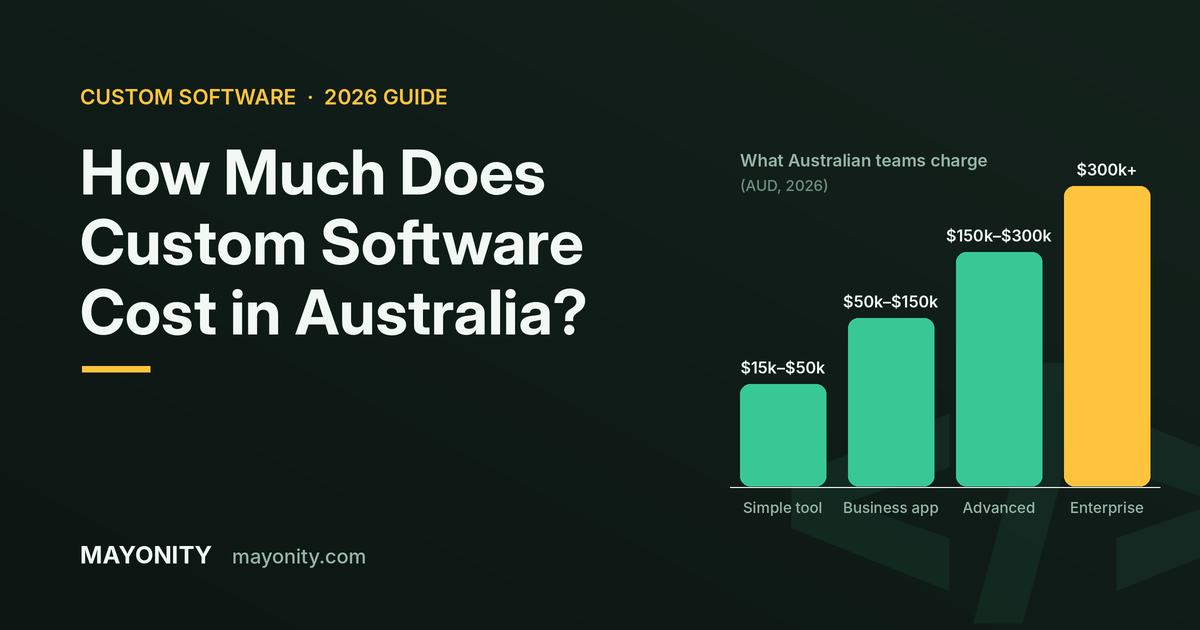
Here is what local guides and agencies are quoting through 2026:
| Project type | What it usually includes | Typical cost (AUD) | Timeline |
|---|---|---|---|
| Simple tool or MVP | one core workflow, a few screens, a basic backend | $15,000 – $50,000 | 2 – 4 months |
| Mid-size business app | user accounts, an admin panel, a few integrations, payments | $50,000 – $150,000 | 4 – 8 months |
| Advanced platform | complex logic, real-time features, reporting, several user types | $150,000 – $300,000 | 6 – 12 months |
| Enterprise system | multiple modules, legacy integrations, strict security | $300,000 – $600,000+ | 9 months and up |
Most small and mid-sized projects land between $30,000 and $150,000.
The bands overlap because studios draw the lines in different places. One firm's "simple" is another firm's "mid-size", so the same brief changes price depending on who reads it. Hourly rates are steadier. Australian agencies and senior developers generally charge between $100 and $250 an hour, with the top of that range for senior and specialist work.
The sources for these numbers are listed at the end.
Why two quotes for the same idea look nothing alike
A handful of things move a quote up or down more than anything else.
The first is how many people use the software and how. A tool one team logs into is cheap. A platform that customers, staff and admins all use is really three products wearing one name.
The second is integrations. Every system your software has to connect to — a payment provider, your accounting software, a CRM, an old database someone set up years ago — is real work, and some of it is slow going.
The third is how finished it has to be on day one. A rough first version that proves the idea costs a fraction of a polished product with every edge case handled. A lot of money gets spent on the last ten percent.
After that it's the usual: a design drawn from scratch versus a sensible component library, how much testing and security the work needs, and whether the scope stays still or keeps growing while you build. The moving scope is the one that quietly doubles budgets.
What you can build on a startup budget
Most of the founders who email us don't have $50,000. They have an idea they believe in, a few thousand dollars, and a cost table telling them they can't afford to start. Usually they can. They just need a smaller first version.
At $15,000 to $30,000 you can build a real first version, as long as you cut scope and not quality. In practice that means:
- One core workflow, done properly. Pick the single thing the software is for and build that, not the ten things you might add later.
- Four or five screens, not twenty.
- Hosted services for the plumbing. Payments through Stripe, sign-in through a ready-made provider, instead of building either from scratch.
- No admin panel in version one. Run it from the database or a spreadsheet until you have enough users to justify a screen for it.
- A proper component library for the look, not a design built pixel by pixel.
Three things are worth paying for even on a tight budget: testing, a backend you actually own, and code another developer can pick up later. Those are what make version two cheap. Skip them and you pay for the software twice.
Our own project minimum is USD 1,000, around AUD 1,500, so a small and clearly scoped first phase is work we will take on. If the budget doesn't fit the idea, we will tell you what it does fit instead of quietly cutting things you can't see.
The costs that start after launch
The build is not the whole bill. Once software is live it needs looking after, and a quote that ignores this is hiding the real number.
Budget roughly 15 to 20 percent of the build cost each year for maintenance — fixing things, keeping libraries current, and small changes as you learn what users actually want. On top of that there is hosting, which is usually modest, and support if you want someone on hand when something breaks. Software that is left untouched for a year doesn't stay still; it slowly stops working as the things around it update.
Local team or offshore: the honest version
An Australian team in the same timezone, able to sit in a room with you, is worth something real. You will also pay $100 to $250 an hour for it. An offshore team costs a fraction of that, and the trade is the one you would expect: different hours, and more care needed on communication.
The honest middle is this. If your project is large, tightly regulated, or needs constant in-person work, a local team earns its rate. If you are a startup or a small business trying to get a solid product built without spending your runway on it, a good remote team is a real option, not a compromise — as long as you pick one that writes things down and shows you working software every week.
How we price work at Mayonity
We are a remote team. We don't have an office in Australia, which is exactly why our pricing sits well below a local agency for the same scope.
We don't sell fixed packages, because the scope sets the price. Every project starts with a call and a written quote covering scope, timeline and price, so you know the number before any work begins. For a first phase we quote a fixed price up front. You can see how we work in our portfolio and read more about working with Australian businesses.
Questions to ask before you sign anything
Ask every vendor the same questions and the quotes suddenly become comparable:
- What exactly is included, and what counts as "extra" later?
- Who owns the code and the accounts when the project ends?
- Is the first version a real product or a prototype?
- How will I see progress, and how often?
- What does it cost to run and maintain after launch?
- What happens if the scope changes midway?
- How many rounds of changes are included?
A vendor who answers all seven in writing is one you can trust with a quote. One who gets vague on ownership or "extras" is telling you something.
Frequently asked questions
How much does custom software cost in Australia?
For a locally built project, roughly $15,000 for a simple tool up to $600,000 or more for a large enterprise system, with most small and mid-sized work landing between $30,000 and $150,000. A remote team costs a good deal less for the same scope.
What is the minimum budget to get started?
A genuine first version starts around $15,000 with a local team. With a remote team you can start lower — our own minimum is about AUD 1,500. Below that you are buying a template or a prototype, not software you can build on.
Why are Australian quotes so much higher than offshore ones?
Local rates run $100 to $250 an hour because Australian salaries and office costs are high. A remote team carries none of that, which is where the difference comes from, not the quality of the work.
How long does custom software take to build?
Two to four months for a simple tool, four to eight for a mid-size business app, and longer for anything complex. A scope that keeps changing adds time to all of these.
Do I need to pay for maintenance after launch?
Yes. Budget 15 to 20 percent of the build cost a year. Software that isn't maintained slowly breaks as the services and devices around it change.
Getting a real number for your project
The ranges here are a sanity check, not a quote. The only way to know what your software costs is to describe what you are trying to do and have someone scope it properly.
That is a free call with us. We will tell you a realistic number, what we would build first, and what we would leave for later — and if a remote team isn't the right fit for your project, we will say so.
Sources for price ranges
- Hatchet — How Much Does Custom Software Cost in Australia? (2026)
- Apptunix — Software Development Cost in Australia (2026)
- Appinventiv — Software Development Cost in Australia (2026 Guide)
- Expeed — Custom Software Cost Australia (2026)
- GMTA Software — Custom Software Development Cost in Australia
- What's The Damage — Web Development Cost in Australia (2026)
- Cipher Projects — Custom Software Development Cost Australia (2026)